

The early fracture —
where observation begins
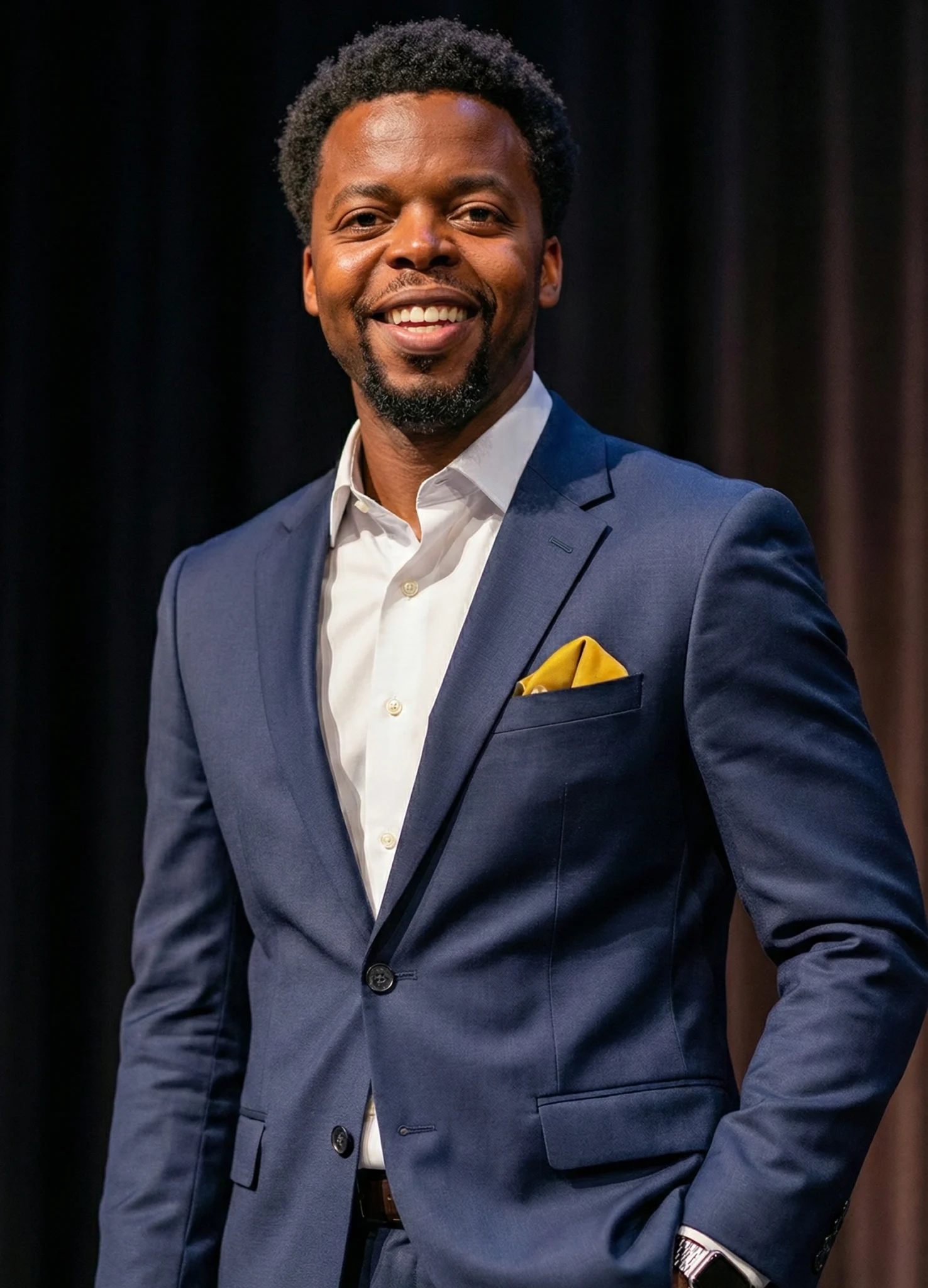
Christopher Fredrick-Orumah's journey into psychology and human development did not begin in a classroom. It began in early childhood — with loss, and with the particular kind of attention that loss produces in a young mind trying to make sense of the world around it.
After losing his mother at the age of two, he grew up acutely aware of emotional absence, relational instability, and the profound ways in which environment shapes a developing mind. Without the support systems many children naturally inherit, he became deeply observant — of people, of behaviour, of the invisible emotional currents that run beneath ordinary interactions.
"I became a student of people long before I became a student of psychology. Necessity made me observational. Observation eventually made me curious. Curiosity, eventually, made everything else."
— Christopher Fredrick-OrumahWhat might have remained simply a painful chapter of childhood became, in retrospect, the first layer of a cognitive and psychological education — one that no formal institution could have provided. The capacity to read emotional environments, to notice what is not said, to sense the architecture of a relationship before it is articulated: these did not come from books. They came from necessity.
Adaptation & intelligence —
survival as a cognitive system
From early on, adaptation was not a choice — it was a requirement. Learning to connect across different age groups, personalities, and social environments developed an unusual sensitivity to human behaviour, social dynamics, and interpersonal nuance. Creativity, observation, and psychological adaptability became survival tools long before they became academic interests.
In retrospect, this period was the formation of what the MindGraph Framework would later name Layer 04 and Layer 05 — sociocultural positioning and creative adaptive intelligence. The ability to read systems from the outside, to find points of entry into unfamiliar social structures, to generate new responses to environments that offered no obvious template: these capacities were developed, through lived necessity, before they were ever named.
This is important not as biography but as methodology. The insight that shapes MindGraph's entire approach — that psychological transformation is structural, not motivational — has its roots here. When the environment offers no reliable external structure, you build internal ones. When external models fail, you develop your own. That understanding did not come from a textbook. It was lived.
"Hardship either makes you rigid or adaptive. The difference, I later understood, is not willpower. It is the depth at which you engage with experience — whether you process it or merely endure it."
— Christopher Fredrick-Orumah
The discipline of understanding —
a father's intellectual legacy
Alongside these formative experiences came another defining influence — one that would prove equally foundational to everything MindGraph would become. Until the age of eighteen, Christopher's father required him to read extensively and, crucially, to summarise every book he completed.
This was not a casual exercise. It was a discipline of comprehension — a demand not merely to consume information but to understand it well enough to translate it, to extract its structure, to articulate its argument in his own terms. Week after week, the same requirement: read deeply, understand genuinely, communicate clearly.
Extensive reading across disciplines — history, philosophy, psychology, biography, science. No single subject. Breadth as a discipline in itself.
Written summaries of every book completed — a practice that built not speed-reading but deep comprehension and critical synthesis.
Research as a discipline, not a utility — the habit of understanding phenomena beyond their surface appearances, of asking why before accepting what.
"My father understood something that most education systems do not: that comprehension is not the same as consumption. He was not building a reader. He was building a thinker."
— Christopher Fredrick-OrumahThis early training laid the foundation for what would later become MindGraph's core philosophy: that transformation requires more than inspiration — it requires understanding. Not the feeling of insight but the structural capacity to see how things actually work and why. The discipline of deep comprehension, instilled long before any formal academic training, became the intellectual spine of everything that followed.
The formal pursuit —
psychology meets lived experience
What began as a personal attempt to understand cognitive struggle, emotional complexity, and human behaviour gradually evolved into a lifelong academic and practical pursuit. The question that drove it was not abstract — it was the same question that had shaped his childhood: how does the mind actually work, and what determines whether a person thrives or merely survives under pressure?
This journey led to formal study in both sociocultural anthropology and psychology — disciplines chosen not arbitrarily but because together they address the full complexity of the question. Psychology alone examines the individual mind. Anthropology examines the cultural systems that shape it. The insight that these two cannot be separated — that cognition is always embedded in culture, that identity is always partially constructed by social systems — became central to the MindGraph approach.
Advanced postgraduate training deepened an interdisciplinary understanding of human development, identity, cognition, behaviour, resilience, and cultural influence. Rather than separating psychology from lived experience, or academic theory from practical application, the work consistently sought the point where they converge.
"Formal study gave me the language and the framework. But the questions had been there long before the qualifications. The learning was always in the service of understanding — not the credential."
— Christopher Fredrick-OrumahThe result is an approach to human development that is simultaneously academically grounded and practically applied — drawing on a century of psychological and anthropological research, but always in service of the person sitting in front of you, navigating the specific complexity of their specific life.
Why MindGraph exists —
from biography to institution
MindGraph was created in response to a growing and observable reality: many intelligent, motivated, high-functioning people are overwhelmed — intellectually, emotionally, culturally, and psychologically — yet lack the frameworks to understand why, or to do anything about it that lasts beyond the initial resolve.
The self-development industry offers abundant motivation and insufficient understanding. It addresses symptoms without examining the systems generating them. It produces temporary change without structural transformation. It treats the mind as something to be optimised rather than understood — as a performance machine rather than a living, contextual, relational system.
MindGraph exists as the alternative. Not as a reaction to the industry, but as a genuine conviction — rooted in both lived experience and formal study — that the depth of understanding changes the quality of transformation. That when people genuinely comprehend the architecture of their own thinking, feeling, and behaving, they do not simply change their habits. They redesign their lives.
"This is not the story of someone who found a method and built a business around it. It is the story of someone who lived the questions long enough that the framework emerged from the answers."
— Christopher Fredrick-OrumahThe transition from "this happened to me" to "this shaped the systems I now build to help others" is the entire point of MindGraph's existence. Every element of the Framework — every layer, every programme, every question in the Cognitive Audit — is rooted not in theory alone but in the intersection of rigorous academic study and the kind of understanding that only comes from having genuinely needed to understand.